Epoxy Garage Floors and Concrete Coatings in Highland, CA

Twenty years of coating slabs across Highland and the San Bernardino Valley, with the moisture reading written into your proposal before any material is ordered.

Highland Epoxy Flooring has spent more than twenty years installing epoxy garage floors, polished concrete, polyaspartic coatings and commercial floor systems across Highland, CA and the surrounding San Bernardino Valley. We coat residential garages, restaurant and back-of-house kitchens, auto service bays, shop floors and light industrial space, and we quote all of it from a slab we have actually looked at and tested.

This is a homeowner-garage city before it is anything else. Roughly three quarters of the housing here is single-family detached, and something on the order of eight thousand owner-occupied detached houses sit behind those numbers. More than half of the city’s housing went up between 1980 and 2009, which means the slab we are most often asked to coat is a thirty to forty-five year old attached two-car bay that has settled, cracked along its control joints, collected oil under where the car sits, and very often already carries a failed one-part paint or a store-bought kit that has to come off before anything new goes down.

That last point is why our proposals look different from most. Removal of a prior coating is quoted as its own line of work rather than folded invisibly into a square-foot price, moisture is measured before material is ordered, and the surface profile we are grinding to is named rather than left to chance. None of that is exotic. It is simply the part of the job that decides whether the floor is still bonded in five years.

Get Your Free Quote

Fast response • No obligation

So we can reach you about your request.

So we can send you a confirmation after you submit this inquiry form.

  • 20+ Years Experience
  • Licensed & Insured
  • Free Written Estimates

What we do

Our Services

Epoxy flooring and concrete coatings in Highland, CA

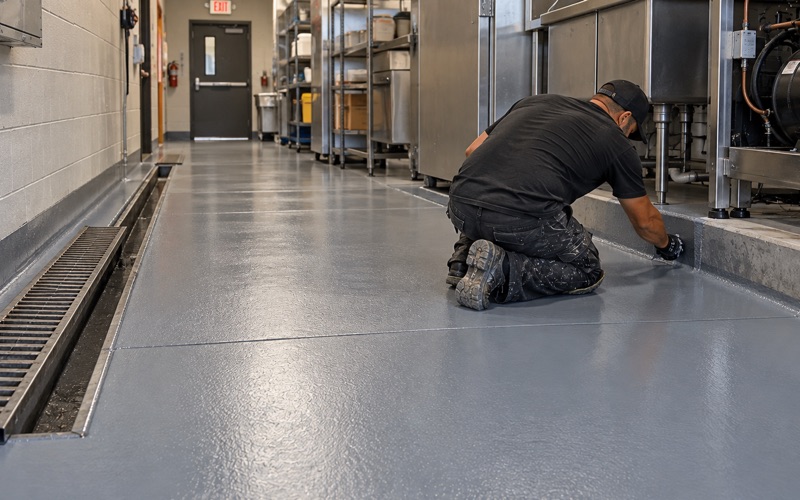
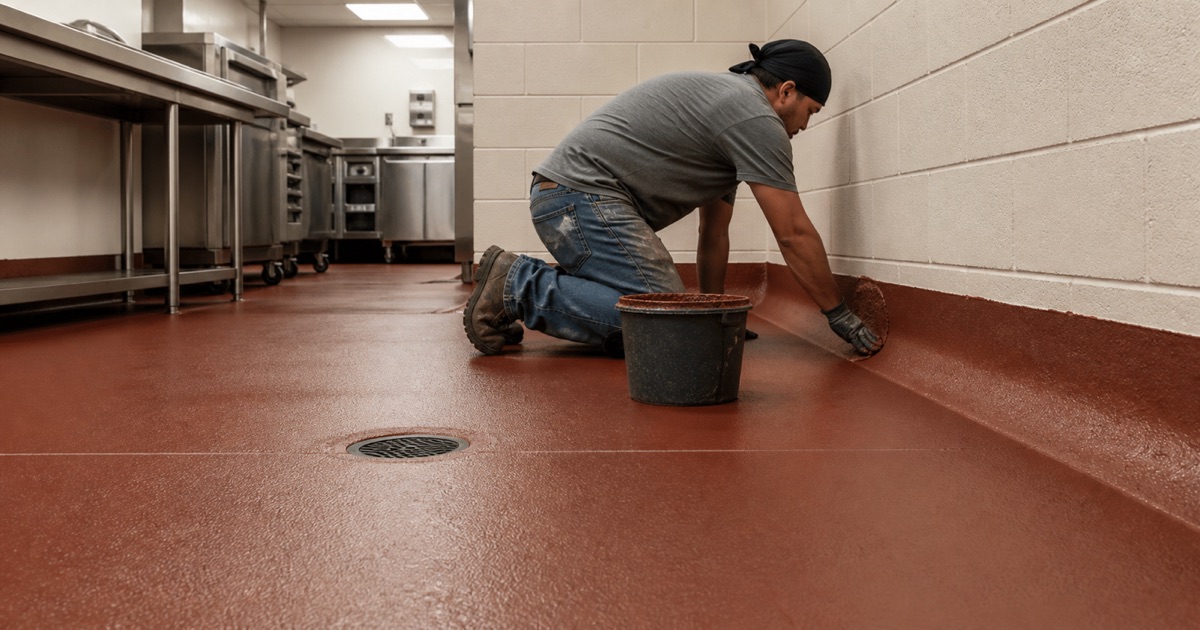
A kneeling applicator presses urethane cement into a coved base along a commercial kitchen wall with a floor drain nearby.

Epoxy Garage Floor

Epoxy garage floor systems for Highland homes, specified from a moisture reading and a named surface profile rather than from a product catalog.

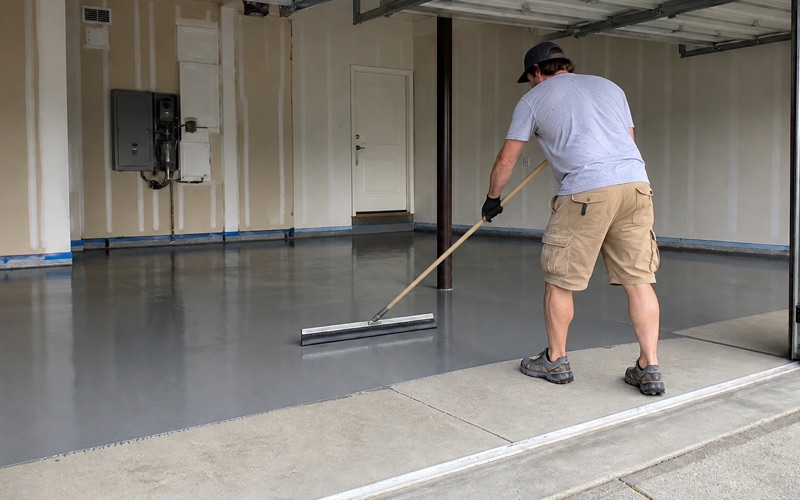
An applicator pulls a wide squeegee of wet gray epoxy base coat across a garage slab toward the roll-up door threshold.

Polished Concrete Flooring

Mechanically polished concrete floors for Highland homes and businesses, with aggregate exposure and sheen decided from the slab rather than a brochure.

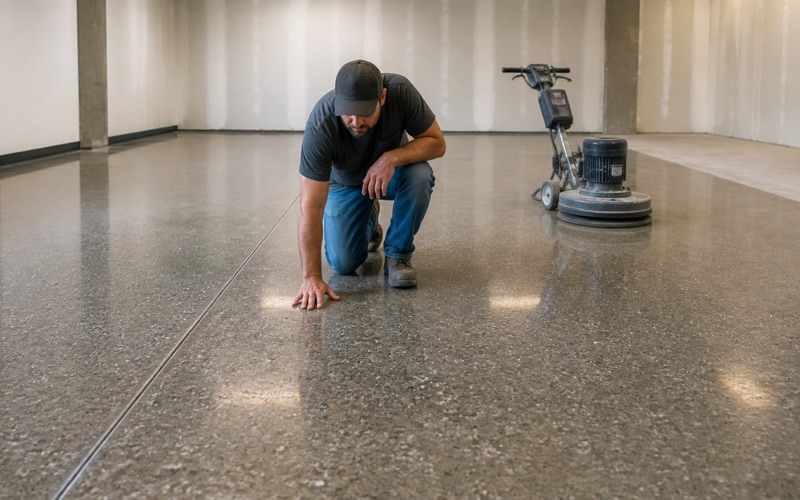
A finisher crouches with a flat palm on a polished concrete floor beside a filled saw-cut joint in a tilt-up tenant space.

Polyaspartic Floor Coating

Polyaspartic floor coatings installed in Highland, scheduled around slab temperature and gel time rather than around a convenient calendar date.

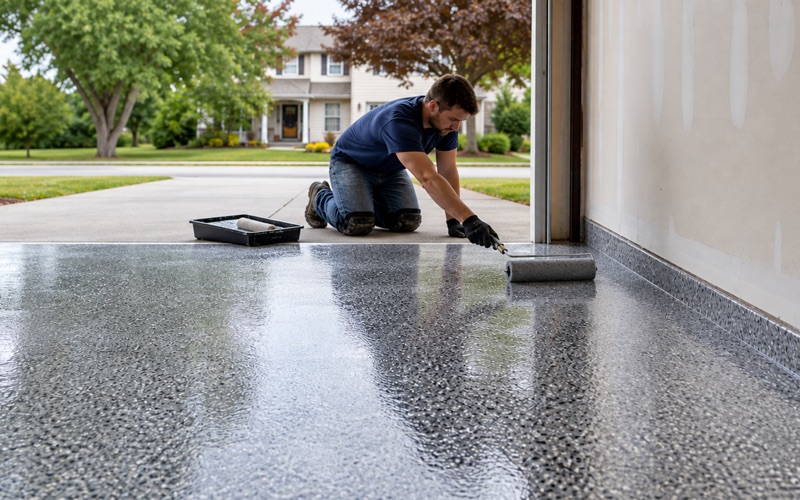
A kneeling installer back-rolls a glossy clear polyaspartic topcoat over a flake garage floor that continues out to the driveway apron.

Concrete Resurfacing

New wearing surfaces for slabs past coating: overlays, spall and joint repair, and moisture testing before any material is ordered.

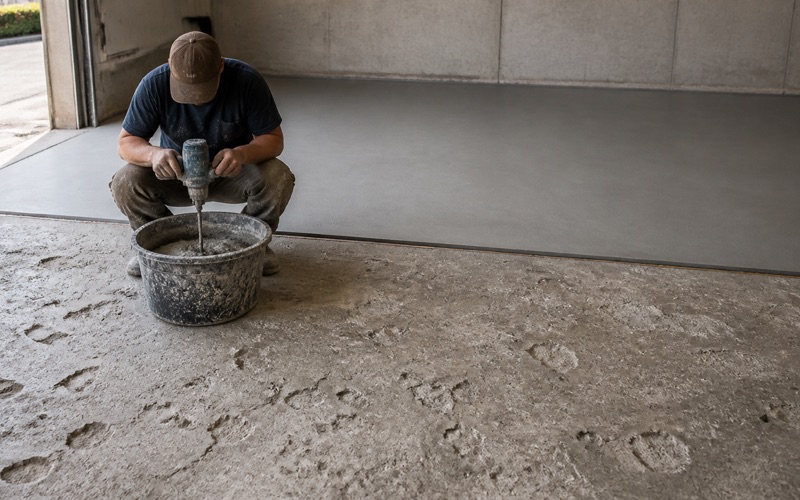
A worker mixes overlay material in a bucket on the floor beside a spalled slab that is half covered with fresh gray resurfacing.

Commercial Epoxy Flooring

Commercial floors specified by exposure: kitchens, service bays and back-of-house, with slip resistance, coved base and moisture testing in writing.

An applicator smooths gray coating up the edge of a concrete equipment pad in a service corridor beside an open trench drain.

Concrete Surface Prep

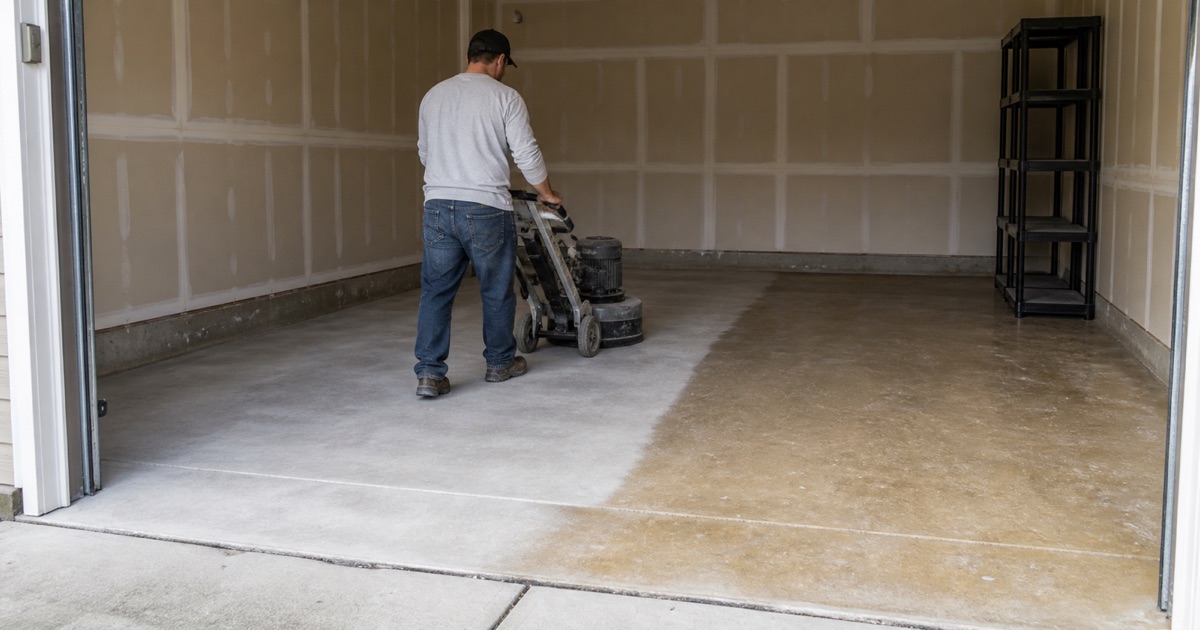
Mechanical concrete grinding to a named ICRI surface profile, with diamond, shot blast or PCD tooling chosen against the hardness of your slab.

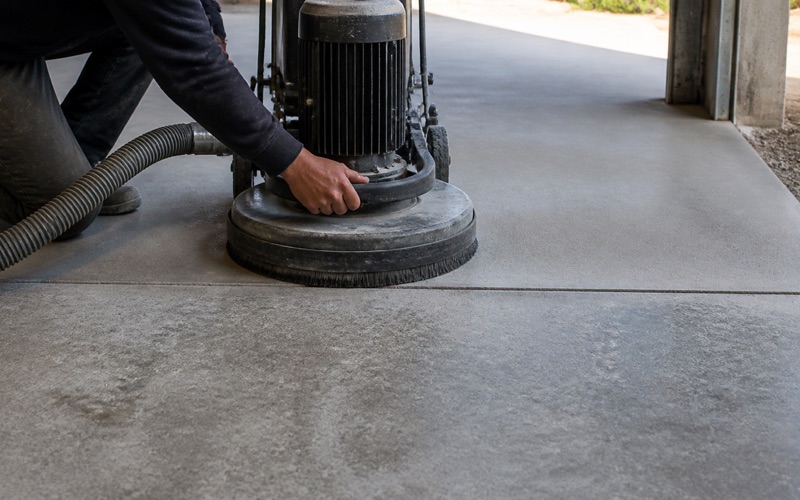
An operator crouches with one hand on the dust shroud collar of a walk-behind grinder that has ground half the shop bay floor open and matte.

Metallic Epoxy Floor

Metallic epoxy floors installed in Highland, with an honest account of what the technique can be asked to do and what it cannot.

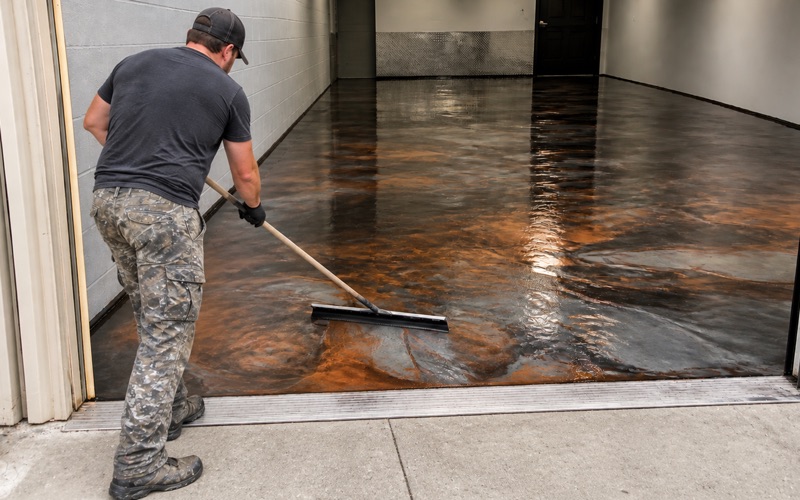
A kneeling applicator draws a spiked roller through a wet metallic epoxy pour marbled in pewter, charcoal and copper.

Flake Epoxy Floor

Flake epoxy floors for Highland garages and shops, quoted with the chip size, the broadcast rate and the grout coat all stated up front.

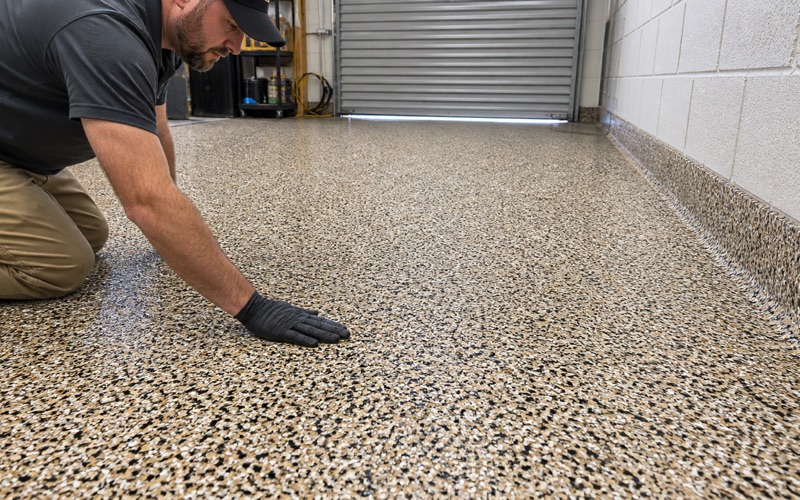
An installer sweeps a gloved hand flat across a dense tan, black and white flake floor that curves up into a coved base at the wall.

Pool Deck Coating

Pool deck surfaces specified for wet slip resistance, cooler color and UV-stable topcoats that survive chlorine, salt and full afternoon sun.

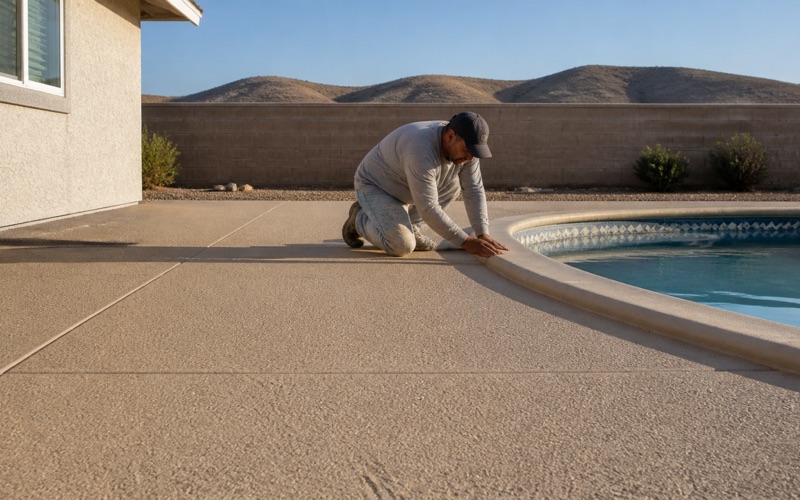
A finisher kneels with a flat palm on a sand-colored textured pool deck coating at the bullnose coping curb.

Concrete Driveway Coating

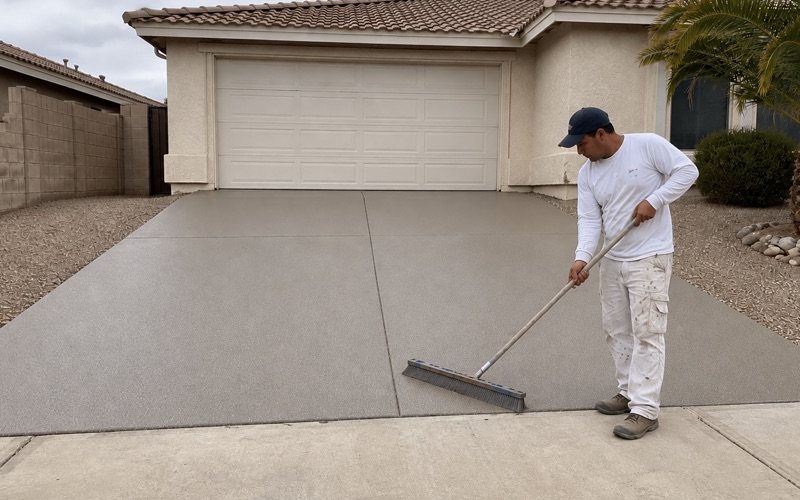
Driveway systems built for hot tire pickup, direct sun and daily slab movement, with joints, grade and drainage assessed before anything goes down.

Two Decades of Coated Slabs in the San Bernardino Valley

Twenty Years in This Trade

We have been coating concrete for more than twenty years, which in this trade mostly means we have seen the failures. Grinding a floor that somebody else installed two years earlier teaches you more about specification than any data sheet, and most of what appears on the rest of this page came from exactly that.

Why Choose Highland Epoxy Flooring

Moisture Tested Before You Are Quoted

Every proposal we write carries a slab moisture reading taken with in-situ relative humidity probes to ASTM F2170, or calcium chloride to ASTM F1869 where that suits the slab better, so the number that decides whether a moisture vapor barrier primer is needed exists before you sign rather than after a floor has lifted.

Every Garage Slab, Regardless of Age

No garage slab here is assumed dry because it looks new. The California Residential Code exempts garages from the under-slab vapor retarder requirement that covers living space, so a 2004 tract bay off Greenspot Road can sit on bare base course exactly like a 1948 slab near the original townsite, and only a test separates them.

Named Surface Profile, Never An Acid Etch

We open concrete mechanically to a specified ICRI concrete surface profile, typically CSP 3 or CSP 4 against the system’s mil build, rather than acid etching. Etching leaves a shallow inconsistent profile and residue that must be rinsed back into the slab, so adhesion becomes a gamble instead of a specification.

Coating Removal Priced As Its Own Work

Most Highland garages built in the eighties and nineties have been painted at least once, so stripping a failed film is real labor and we price it as a visible line. Diamond segment bond is selected against the hardness of the slab in front of us, on the rule that hard concrete takes a soft bond, rather than running one grit sequence across every driveway in the city.

Coating category is chosen against South Coast AQMD Rule 1113, which caps floor coatings at 50 g/L VOC and industrial maintenance coatings at 100 g/L and makes the two mutually exclusive. Residential and commercial work is quoted from separate product lines because that rule draws a legal boundary, so nothing leaves our shop that is illegal in the building it is going into.

Scheduled Against The Slab, Not The Calendar

We book installations against slab temperature and dew point rather than a date that suited the office. Pot life on a hot inland afternoon can run a third of what the same product allows in cool weather and recoat minimums collapse with it, so an early start protects the floor rather than merely the crew.

The Tract-Home Garage, Slab to Sealed

A worker kneels with one gloved hand flat on a finished tan and gray flake garage floor that ends at the open roll-up door threshold.

What A Garage Floor Coating Actually Involves

A coating is four jobs in sequence: strip whatever is down, open the concrete, repair it, then build the system. We walk the slab first, test it, and write the sequence into the proposal so you know what each day looks like. The coating itself is the shortest part of the work.

The Eighties Tract Bay We See Most Often

The modal job in this city is an attached two-car garage on a slab poured somewhere between 1980 and 2009, and close to nine thousand housing units here fall in that window. Those slabs have settled, cracked at the control joints and usually carry a prior coating. We scope them as removal-and-rebuild rather than as a fresh pour.

Emptying The Garage, And Who Moves What

A garage that has held thirty years of storage has to be completely clear before grinding starts, including shelving anchored to the wall and anything on the floor line. We tell you plainly what we move and what we cannot, because a half-empty garage costs a day and a rescheduled crew.

Testing An Older Slab Before A Pail Is Ordered

On any slab with age on it we take a moisture vapor emission rate or an in-situ relative humidity reading before ordering material, because the result changes the primer and sometimes the entire system. Ordering first and testing later is how a job becomes a change order.

Why A New-Looking Slab Still Gets Tested

California’s residential code exempts garages from the under-slab vapor retarder rule that applies to conditioned space, so a garage poured last decade may sit on nothing. ASTM E1745, which defines a modern retarder, only dates to 1997. Age narrows the odds and settles nothing, so we test regardless.

Grinding The Slab Open

Coatings bond to a mechanical profile, not to a smooth surface. Troweled or sealed concrete gives a resin almost nothing to key into, which is why a floor coated over a sealer lets go in sheets. We grind to a named profile, then check it before priming rather than after.

Control Joints, Spalls And The Oil Stain

Control joints get a semi-rigid epoxy joint filler so the coating has support at the edge instead of a void. Spalls and pop-outs are patched to level, and the oil-soaked area under where the car has parted for twenty years is degreased and ground back, because oil in the top of a slab defeats adhesion locally.

Edges, Thresholds And The Step-Down

The difference between a professional floor and a weekend one is visible entirely at the edges. We cut the coating in cleanly at the wall line, carry it over the door threshold to a deliberate stopping point, and detail the step-down into the house rather than letting the system feather out and chip.

Hot Tires, Parking, And The Actual Wait

Foot traffic usually returns the next day and vehicles take longer, because hot tire pickup is a real failure mode where a warm tire softens an under-cured film and lifts it. Polyaspartic topcoats shorten that wait considerably. We give you the number for the system actually going down, not a generic one.

When the Last Coating Failed

An operator pushes a walk-behind planetary grinder across a garage slab where freshly ground concrete meets an older sealed half.

Reading The Peel Pattern

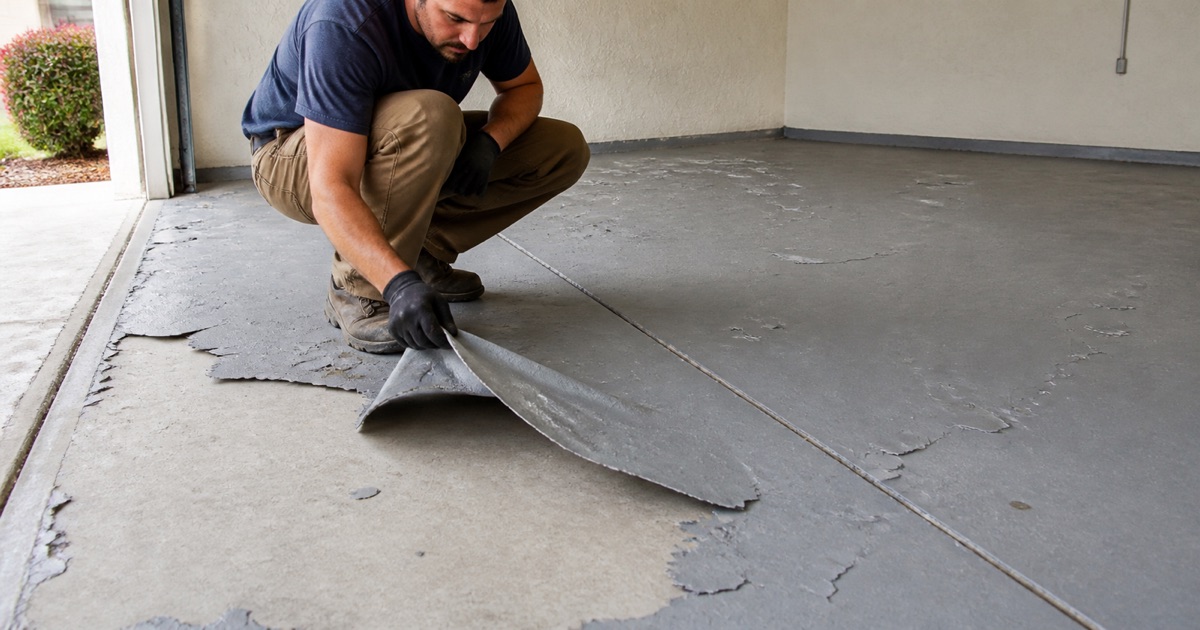
How a coating fails tells you why. A film lifting in wide sheets with clean concrete underneath points at a bond failure from poor preparation; blisters with a chalky white deposit under them point at moisture and alkalinity moving up through the slab. We diagnose before quoting because the two problems have different fixes.

Taking Off A Store-Bought Kit

Removing a consumer kit is harder than starting from bare concrete, which is the opposite of what most people expect. The film is thin and flexible enough to load up grinding tooling, so it comes off with PCD attachments before conventional diamonds can do anything useful. We price that reality rather than discovering it on site.

One-Part Paint On A Slab With No Retarder

One-part garage paint fails particularly fast in this city because so much of the housing stock predates modern vapor retarder practice. Roughly a fifth of the homes here were built before 1960. Vapor moving up meets a film with almost no permeability tolerance, and the paint lifts in patches that map the wet part of the floor.

Bubbles, Blisters And The Reading Behind Them

Blistering is a symptom with a number attached to it. We take a moisture reading before proposing a repair, because if the emission rate is high the only durable answer is a moisture mitigation primer or a vapor barrier system, not a thicker coat of the same product that already failed.

Grinding, Shot Blasting And PCD Tooling

Each method has a job. Diamond grinding is the general-purpose route and gives the most controllable profile; shot blasting opens a large open floor quickly and aggressively; PCD tooling exists to tear off stubborn coatings that would glaze ordinary segments. Choosing wrong wastes a day or ruins a profile.

Matching The Diamond Bond To The Slab

The rule reads backwards until you have done it: hard concrete takes a soft bond and soft concrete takes a hard one. A soft bond wears away fast enough to keep exposing fresh diamond against a hard slab, while a hard bond glazes over and stops cutting. We test-cut before committing a grit sequence.

Chalky, Dusting Concrete

A floor that leaves powder on your hand is either a weak surface layer from a poor original finish or the residue of a sealer breaking down. Either way it is not a bonding surface. Grinding past it to sound concrete is the only fix, and how deep that goes is something we establish on site.

What A Coating Warranty Leaves Out

This is the question almost nobody asks. Moisture is the dominant failure mode in this trade and it is the exclusion most coating warranties in this industry carry, which means the most likely failure is often the one you are not covered for. We state exclusions in writing next to the coverage.

When A Slab Is Past Coating

Some slabs are too far gone to coat and need resurfacing instead. Heavy spalling across a large share of the floor, structural cracking that is still moving, or an alkali-silica reaction working through the concrete are all signs that a coating would simply be a film over a failing substrate.

Choosing Color, Flake and Finish

A crouching worker peels back a sheet of failed gray floor paint, exposing clean concrete beneath it.

Flake Blends And Chip Size

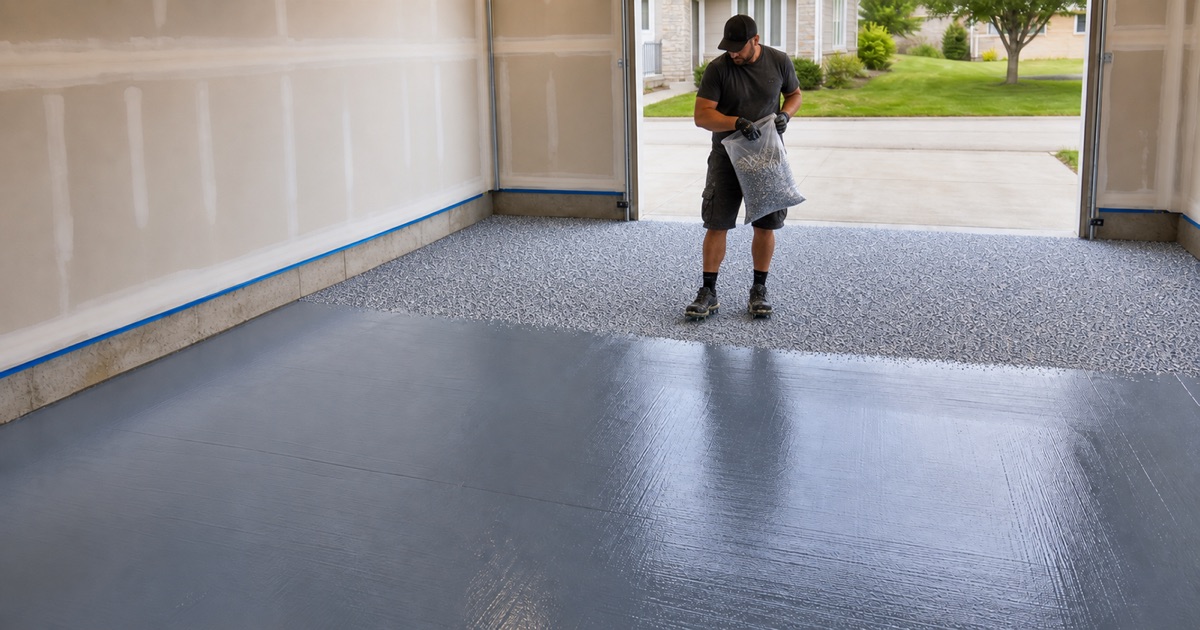
Vinyl flake is broadcast into a wet base coat and the chip size changes the whole character of the floor. Quarter-inch chip reads as texture from standing height; full one-inch chip reads as a bold terrazzo-like pattern. Larger chip also builds more thickness, which affects the topcoat quantity.

Full Broadcast Versus A Lighter Scatter

A full broadcast means flake is thrown to refusal until no base coat shows, then scraped and topcoated, giving a dense uniform surface that hides tire marks and dirt extremely well. A lighter scatter leaves base color visible between chips for a more restrained look, and shows wear sooner in a working bay.

Metallic Floors And Where They Belong

Metallic pigment moved through a clear resin produces a marbled, three-dimensional effect that suits a showroom, a display garage or a finished interior. It is a poor choice for a working shop floor, because the effect is in a thin decorative layer and every scratch reads against the pattern.

Solid Color In A Working Shop

Solid color remains the right answer wherever the floor is a tool rather than a feature. It is the cheapest system to install, the easiest to touch up years later, and it makes a dropped part or a fluid leak immediately visible, which matters in a service bay far more than depth of appearance does.

Gloss, Satin And Matte

Gloss maximizes light return and makes a garage feel considerably brighter, but it also shows dust, tire marks and every imperfection in the slab beneath. Satin is the usual compromise. Matte hides the most and is the easiest to live with day to day in a floor that will not be cleaned weekly.

Quartz Broadcast Where Slip Resistance Leads

Where traction matters more than appearance, we broadcast quartz aggregate rather than vinyl flake. Quartz builds an aggressive, hard-wearing profile suited to wet areas, ramps and commercial entries, and the broadcast rate is specified rather than eyeballed because it directly determines the finished texture.

Matching A Garage To A Driveway Or Patio

Coating a garage and leaving the driveway bare draws a hard line right where the eye lands. Exterior concrete takes different products with ultraviolet stability that interior systems do not need, so matching across the threshold is a question of coordinating two specifications rather than using one.

Color Under A West-Facing Afternoon

A west-facing garage in this valley takes direct heat through the afternoon, and an uninsulated slab can approach a surface temperature of 160 degrees F in summer. That affects installation, and it affects color choice too, because darker floors absorb more and read considerably warmer underfoot in an open bay.

Saw-Cut Lines, Borders And Inlays

Decorative saw cuts, contrasting borders and a logo inlay are all achievable and all cost layout time rather than material. The work is in the masking, the sequencing of coats and the precision of the cut, so we quote these by the complexity of the layout instead of by the square foot.

Kitchens, Shop Floors and Back-of-House

An installer casts an arc of blue-gray and white flake from an open palm over a wet epoxy base coat in a garage bay.

What A Commercial Kitchen Floor Specification Needs

A kitchen floor has to be cleanable, slip resistant when wet, resistant to thermal shock where hot water and steam hit it, and detailed so the wall junction does not trap soil. Those are the properties to specify. We write them into the scope rather than describing a product by brand.

Why No Floor Coating Is USDA Approved

This claim appears on competitor sites constantly and it is not true. There is no federal product approval list for flooring; 9 CFR 416.2(b)(2) is performance-based and speaks to whether surfaces can be kept clean and sanitary. Ask instead for the actual properties an inspection will look at.

Integral Coved Base At The Wall Junction

The wall junction is where a kitchen floor fails first, because a square corner collects soil and a separate base tile opens a seam. An integral coved base carries the floor system continuously up the wall as one monolithic surface, so there is no joint at floor level for water to get behind.

Slip Resistance As A DCOF Number

“Slip resistant” on its own means nothing. Dynamic coefficient of friction is measurable, and specifying a DCOF value for a wet commercial floor turns a marketing adjective into something an inspector and a risk manager can both check. Texture is delivered by broadcast rate, which is why that gets specified too.

Urethane Cement Where Thermal Shock Lives

Behind a kitchen line, in a dish room or anywhere steam and boiling water reach the floor, urethane cement outperforms epoxy substantially. It tolerates thermal shock that would cause a rigid epoxy to debond, and it can be placed at greater thickness, which is what a heavy-duty wet production floor actually needs.

Coolers, Freezers And A Slab That Stays Cold

A walk-in cooler or freezer slab never reaches the temperature most resins need to cure, so the ordinary product list does not apply. These floors need systems formulated for low-temperature cure and a realistic plan for how the box is warmed and returned to service, which is a scheduling problem as much as a material one.

Working On Federal Trust Land

The San Manuel Reservation adjoins Highland and is federal trust land, which means it is not under City of Highland or county building jurisdiction. The Yuhaaviatam of San Manuel Nation has its own Building and Safety Act, its own building official and its own permitting process, and work there runs through tribal channels from the outset.

Auto Service Bays

A service bay floor takes brake fluid, oil, coolant, battery acid and dropped tools, so chemical resistance and impact tolerance lead the specification and appearance follows. We build these with a heavier mil build and a chemically resistant topcoat, and we detail the drains and the lift bases rather than coating around them.

Shutdown Windows And Night Work

A commercial floor usually has to be back in service by opening, which makes cure schedule the governing constraint rather than installation speed. Fast-cure polyaspartic systems exist precisely for this, and we plan the sequence backwards from your reopening time so the floor is walkable when your staff arrive.

Areas We Serve

Highland Epoxy Flooring provides epoxy flooring throughout the greater Highland area, with the same crews and the same standards on every job.

Good to know

Frequently Asked Questions

What does an epoxy garage floor cost in Highland?

Price follows the condition of the slab far more than the square footage. A clean, sound two-car bay that needs grinding, joint work and a flake system sits at the low end; the same bay carrying a failed store-bought kit that has to be mechanically removed first costs meaningfully more, because removal is real labor before any coating goes down. We quote removal as its own line rather than burying it, so you can see what you are paying for. Every proposal is written and itemized after we have seen and tested the floor.

How long does a garage floor coating take from start to finish?

Most residential garages are a one or two day installation once the garage is empty. Grinding, joint filling and patching take the first day, coating follows, and then the wait is on cure rather than on us. Foot traffic is usually next day and vehicle traffic runs longer. Slab temperature moves all of it: recoat windows that run twenty-four hours in cool weather can collapse to six on a hot inland afternoon, which is why we schedule against slab temperature and dew point instead of the calendar.

Why do you test a slab for moisture before quoting?

Because moisture is the single most common cause of coating failure and it is the one thing most coating warranties specifically exclude. We measure with in-situ relative humidity probes to ASTM F2170, or calcium chloride to ASTM F1869 where that is the better fit, and the reading goes into the proposal. The plastic sheet test in ASTM D4263 is indicative only and asymmetric: a positive result condemns a slab, but a negative one proves nothing. The threshold numbers themselves live in ASTM F710, not in the test methods.

My garage was built in the nineties. Does it still need a moisture test?

Yes, and this surprises people. The California Residential Code exempts garages from the under-slab vapor retarder requirement that applies to living space, so a garage slab of any age may have been poured over nothing but compacted base. Age narrows the odds but does not settle the question, and ASTM E1745, the standard defining a modern under-slab retarder, was not published until 1997. We test every garage slab regardless of what year it went in.

Can you coat over the epoxy kit I already put down?

Almost never, and coating over it is how a floor fails twice. A one-part garage paint or a big-box kit is a thin film with weak adhesion, so a new system bonds to that film rather than to the concrete and lifts with it. The correct route is mechanical removal, usually diamond grinding with PCD tooling for a stubborn coating, back to bare concrete and a named ICRI surface profile. We quote that as its own scope so the cost is visible up front.

Do you acid etch the concrete first?

No. Acid etching produces an inconsistent, shallow profile and leaves residue that has to be neutralized and rinsed, which reintroduces water to a slab we are about to coat. We open the surface mechanically with diamond grinding or shot blasting to a specified ICRI concrete surface profile, most often CSP 3 or CSP 4 depending on the system and its mil build. The diamond bond is chosen against the hardness of the slab in front of us, on the counterintuitive rule that hard concrete takes a soft bond.

Are you licensed and insured?

Yes. We carry the license and insurance required for this work in California and we will provide current certificates on request before any work is scheduled. We would rather you ask us and every other contractor you are considering, because the answer is easy to verify and it is a reasonable thing to check on a job that involves grinding equipment, dust containment and chemical products inside your building.

What is the difference between epoxy and polyaspartic?

Epoxy is the body of most systems: a two-part resin that builds thickness, bonds hard to prepared concrete and gives you the mil build a working floor needs. Polyaspartic and polyurea are usually the topcoat, curing far faster, holding color against sunlight better and resisting hot tire pickup. Many of the floors we install are a hybrid, an epoxy base with a polyaspartic wear coat, because that combination gives you the build of one and the return-to-service speed of the other.

Does the VOC rule really change which product goes into my building?

It does, and it is a legal line rather than a preference. Highland sits inside South Coast AQMD, where Rule 1113 caps floor coatings at 50 g/L VOC and industrial maintenance coatings at 100 g/L, and the two categories are mutually exclusive by definition. The rule also prohibits applying or soliciting the application of industrial maintenance coatings for residential use. A workshop or barn on a residentially zoned parcel is a residential property under that rule however industrial its wear, so we quote residential and commercial work from separate product lines.

What does your warranty actually cover, and what does it exclude?

We put the exclusions in writing alongside the coverage, because a headline number with the conditions left unsaid is worth very little. The exclusion worth understanding is moisture: vapor driving up through a slab is the dominant failure mode in this trade and it is what most coating warranties in this industry carve out. That is precisely why we test before quoting and why a moisture mitigation primer appears as a priced line when a reading calls for one, rather than as a surprise after a floor has already lifted.

Ready to Get Started?

Request a free quote today and we'll get back to you fast.