
Highland Epoxy Flooring installs concrete driveway coating in Highland, CA and across the surrounding cities including Redlands, Mentone, Loma Linda, Running Springs and San Bernardino, and after twenty years of it we treat a driveway as a different specification from anything under a roof. It carries the same vehicles as a garage bay, but it does it in direct sun, with nothing overhead and a slab that expands and contracts every single day.
That combination narrows the product list quickly. A driveway sees ultraviolet light continuously, reaches surface temperatures no interior slab approaches, and takes the harshest version of tire contact there is, because a car parks on it hot after a drive rather than after backing in cold. Any of those alone rules out several products that are perfectly good indoors.
We also look at the ground the slab sits on before we look at coatings. Highland climbs toward the foothills, and sloping lots, split-level drives and steep aprons are common in the older and eastern tracts, which changes how water leaves the surface and where a coating is most likely to be tested.
What an Exterior Drive Asks For That an Interior Slab Does Not
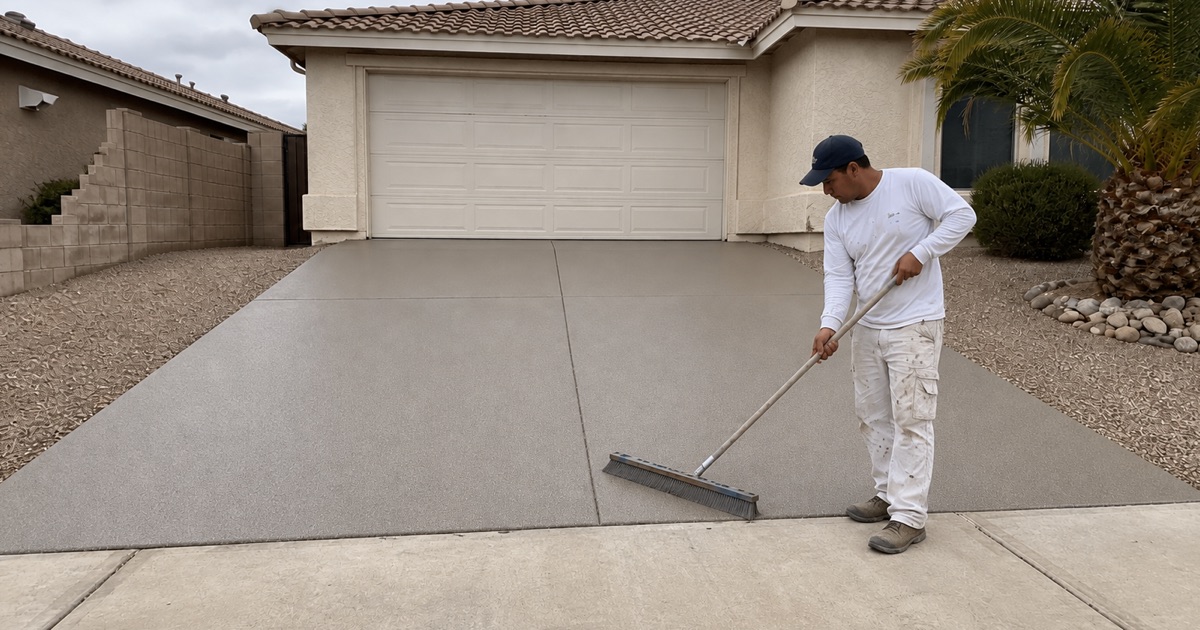
Three exposures do most of the damage on a driveway, and a system that handles all three is a much shorter list than the one a garage floor can choose from.
Hot Tire Pickup
A tire that has been on the road heats up, softens slightly, and then sits parked in one place while it cools. On a coating that has not fully cross-linked, or one whose bond to the slab is weak, the tire lifts the film with it when the car pulls away. Hot tire pickup is a bond and chemistry problem rather than a hardness problem, which is why full cure time and mechanical preparation matter more here than the number on the pail.
Ultraviolet Light and Daily Thermal Cycling
Standard epoxy ambers and chalks in direct sun, so outdoors it belongs beneath a UV-stable topcoat rather than as the exposed surface. The slab underneath is also moving every day, expanding through the afternoon and contracting overnight, which puts a stress on the bond line that an interior floor never sees at that amplitude.
Turning Loads and the Apron
Power steering turned while a car is stationary scrubs a coating in a way straight driving does not, and it concentrates that scrub in the same few spots every time. The apron where the drive meets the street takes the worst of it, along with grit tracked in off the pavement. We specify those areas with the same texture as the rest of the drive but expect them to be the wear indicator.
Systems We Specify for a Driveway
Polyaspartic and Polyurea Topcoats
An exterior drive is built as a system rather than a single product: a primer chosen against the moisture reading, a body coat carrying the color or broadcast, and a UV-stable aliphatic topcoat over it. Polyaspartic and polyurea chemistries hold color in sun, cure fast enough to reopen a driveway quickly, and stay flexible enough to live with a slab that moves daily.
Flake and Quartz Broadcast for Traction and Camouflage
A broadcast of vinyl flake or quartz aggregate does two useful things outdoors. It builds a texture that keeps a wet or sloped drive walkable, and it visually breaks up the surface so grit, tire marks and the inevitable oil drip do not read as obviously as they would on a solid color. Broadcast rate is set against how much traction the slope actually needs.
Penetrating Sealers Where a Film Is the Wrong Answer
Sometimes the honest recommendation is not a coating at all. On a driveway with widespread surface scaling, or one whose moisture readings will not support a film, a penetrating sealer that soaks in rather than sitting on top protects the concrete without creating a bond line that can fail. We say when that is the better value rather than selling the more expensive option by default.
Joints, Cracks and Grade
Driveways are poured in panels with control joints between them for a reason, and outdoor thermal movement is exactly the load those joints exist to absorb. We carry every joint through the coating and fill it with a flexible material rather than coating across it, because a film bridging a moving joint will crack in a line so straight it looks deliberate.
Existing cracks are assessed for whether they are still moving. Static shrinkage cracks are routed, filled and coated over; active ones are treated as joints. Grade gets checked at the same time, since a coating adds a small amount of thickness and a drive that already drains marginally toward the gutter can be tipped into ponding by it. On the split-level and sloping drives common in this city, that check is the difference between a surface that sheds water and one that holds it at the low point.
Cure Conditions and the Legal Product Category
Schedule on an exterior slab is set by the concrete, not by the calendar. The working time a two-part material gives a crew shrinks sharply as the slab warms, and the shortest permitted wait before the next coat shrinks with it, so a mix that was comfortable on a cool morning is unusable by mid-afternoon on the same driveway. We batch small, start early, and take the surface temperature rather than the air temperature.
The second constraint is regulatory. Under South Coast AQMD Rule 1113 a floor coating is held to 50 g/L VOC while an industrial maintenance coating may carry 100, and the two definitions exclude one another outright. Subsection (c)(6) then bars anyone from applying, or soliciting the application of, an industrial maintenance coating for residential use. A house driveway is residential property, so it takes the residential product line.
- 20+ Years Experience
- Licensed & Insured
- Free Written Estimates