
Highland Epoxy Flooring installs polished concrete flooring throughout Highland, CA, and after more than twenty years of grinding slabs in the San Bernardino Valley we can usually tell within one test pass what a given floor is going to give up, serving surrounding cities including Redlands, Mentone, Loma Linda, Running Springs and San Bernardino. Polishing is the one floor on this site that adds nothing to the concrete. The wearing surface is the slab you already own, refined until it holds a sheen.
That single fact governs everything else. There is no film to delaminate, no recoat window to hit and no bond line to fail, but there is also nowhere to hide, because every pass takes the floor closer to what the pour actually contains. A slab with a soft dusty surface, a wandering finish or a patchwork of old repairs will show all of it, and the honest version of this service is being told that before a machine is unloaded.
So we quote polished concrete from the slab outward: how hard it tests, how flat it lies, how deep the cream layer runs before aggregate appears, and what is still stuck to the top of it. Those readings decide the diamond sequence, the level of aggregate exposure and the sheen we can realistically reach. The alternative is bidding a picture from a brochure and finding out on day one that this slab does not make that picture.
What Polishing Actually Does to a Slab
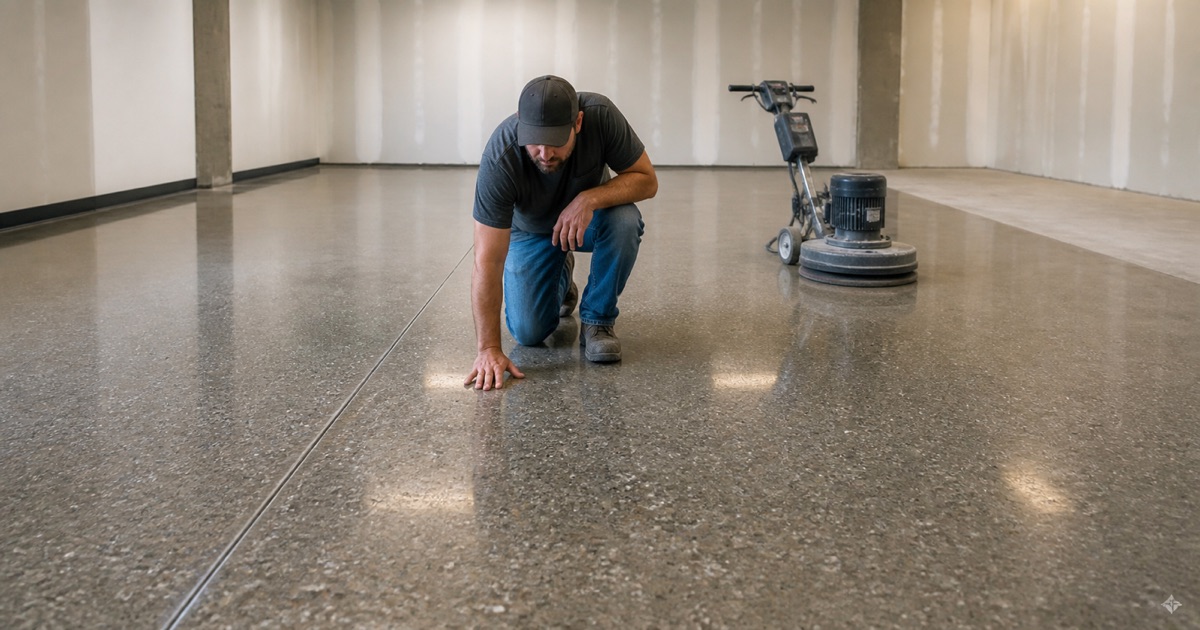
The term covers a sequence of operations that are commonly collapsed into one word, and collapsing them is how two bids for the same floor end up describing two different products at similar prices.
Grinding, Honing and Polishing Are Three Passes, Not One
The first passes use metal-bond diamonds to cut, flatten and open the surface, which is where aggregate exposure is won or lost. Transitional and resin-bond tooling then hones out the scratch pattern the previous grit left behind, each step erasing the one before it. Only the last passes are polishing in the strict sense, and they contribute almost nothing if a coarser scratch was left in the floor four steps earlier.
The Densifier Is What Makes the Surface Hard
Part-way through the sequence the floor is treated with a silicate densifier, which reacts chemically inside the concrete rather than sitting on it. That reaction fills pore structure near the surface and gives the finer grits something dense enough to burnish. Timing it correctly matters more than the brand on the drum: applied too early it is polished straight back off, applied too late it never reaches into an already-closed surface.
Aggregate Exposure Is Chosen Before the First Pass
A finished floor can read as a cream finish with almost no stone, a salt-and-pepper surface showing fine aggregate, or a full exposure showing the large stone in the mix. That choice is made by how aggressively the first cut goes and it is irreversible in one direction only, since more can always be taken off and nothing can be put back. It also depends on how the slab was poured, because the depth of cream is not uniform across every bay.
Whether Your Slab Will Polish
Not every slab is a candidate, and the useful thing a contractor can do at the walkthrough is say so. We test rather than assume, then price the sequence the results call for.
Hardness, and a Bond Rule That Sounds Backwards
Diamond segments are held in a metal matrix, and the matrix has to wear away at a rate that keeps fresh diamond exposed. On hard concrete a soft bond is the correct choice, because the matrix erodes fast enough to keep cutting, while a hard bond glazes over and polishes without removing material. That inversion catches people out constantly, and running one grit sequence across every job regardless of what the slab tests at is the most common reason a floor takes twice the passes it should have.
Flatness, and What the Slab Was Poured For
A floor poured to drain, poured in separate bays on different days, or troweled by different hands will not polish uniformly, and grinding it flat means cutting deeper in the high spots and exposing more stone there. Sometimes that is a feature and sometimes it is a problem the client needs to see coming. Highland’s older and eastern tracts sit on sloping lots with split-level driveways, so a garage or shop slab there frequently carries a deliberate fall that a level polish would fight.
What Is Already Stuck to the Surface
Carpet adhesive, tile thinset, sealers and old paint all have to come off before any grit sequence means anything, and each behaves differently under tooling. Soft mastics load a diamond segment immediately, which is where PCD tooling earns its place ahead of a conventional grind. Efflorescence, a chalky dusting surface or a slab showing signs of alkali-silica reaction are separate warnings, and the last of those is a concrete condition rather than a finishing problem.
Moisture, Joints and What Polishing Does Not Fix
Polished concrete solves one of this trade’s hardest problems and leaves two others exactly where they were. That is worth understanding before choosing between a polish and a coating.
A Polished Floor Breathes
Moisture failure is the dominant way a coated floor comes apart, because vapor moving up through a slab has nowhere to go once a film seals the top of it. A polished surface is not a barrier, so vapor passes through as it always did and there is no bond line for it to push against. On a slab with a genuinely high emission rate, polishing is often the more honest recommendation than a coating plus a mitigation system.
Where We Still Take a Reading
We still test, because moisture shows up in the finish even when it cannot cause delamination. Persistent vapor movement carries salts to the surface and leaves efflorescence that dulls a polish and comes back after cleaning. ASTM F2170 in-situ relative humidity probes read the state inside the slab and ASTM F1869 reads a surface rate, and either one tells us whether to expect that, and whether a topical guard belongs in the specification.
Control Joints and Cracks Stay Where They Are
A saw-cut joint exists so the slab can move, and no amount of polishing changes that. Where wheeled traffic runs across joints we fill them with a semi-rigid epoxy joint filler that supports the edges without stopping the movement, and cracks get repaired on their merits. What we will not do is describe a filled joint as invisible, because polishing makes joints and repairs read more clearly, not less.
Polished Concrete in a Highland House
Roughly 8,100 owner-occupied detached houses sit in this city, and interest in a residential polish usually starts in a room where the slab is already exposed or about to be.
Where It Belongs in a House
Open living areas, kitchens, entries and sun rooms are the rooms where a polished slab makes sense, along with the increasingly common conversion of an attached garage into finished space. It suits a house whose slab is one continuous pour more than one that has been added onto twice, since a matched finish across two eras of concrete is difficult to promise.
The Older Slabs in the Original Townsite
About 22.2% of Highland’s housing predates 1960, concentrated along the older Base Line and Highland Avenue corridors rather than in the ranch tracts. Those slabs are often harder and more variable than a modern pour, with sand-heavy mixes and repairs from several decades. They can polish beautifully and they can also surprise you, which is why we cut a test patch in an inconspicuous corner before committing a number to paper.
Living With the Finish
A polished slab is hard, cool underfoot and reflective enough to carry room noise, so rugs and soft furnishings do more work than they would over wood. Dropped glass breaks and dropped tools mark, though marks in the slab weather in rather than peeling. For most owners the trade is that maintenance drops to mopping and the floor never needs stripping and recoating.
Commercial Polished Concrete
On the commercial side polishing competes on lifetime cost rather than on installed price. The calculation changes with how many hours a week the floor is under traffic.
Retail and Back-of-House Along Base Line
Base Line is Highland’s retail and restaurant spine and the corridor the city names as its town center, and polished concrete suits the sales floor, stockroom and corridor work that goes with it. Where the same tenant improvement includes a kitchen or a wash-down area, those rooms need a resinous system instead, so most of these projects end up as a polish for the dry areas with a coated floor behind the line.
Shops and Flex Space on the 3rd and 5th Street Corridors
Highland’s industrial land sits along the 3rd Street and 5th Street corridors near State Route 210, and it is small-format work: contractor yards, auto service, light manufacturing and flex units rather than high-cube distribution. Polished concrete carries forklift and pallet-jack traffic well as long as the joints are filled properly, and it takes the abuse without a coating’s recoat cycle.
What Maintenance Looks Like Over Ten Years
A polished floor is maintained by scrubbing and periodic burnishing, both of which happen during business hours without closing the space. There is no recoat, no odor and no shutdown window to negotiate, which on a tenant floor is frequently worth more than the difference in installed cost. Where a floor does dull, restoration returns to the finer grits rather than starting the whole sequence again.
- 20+ Years Experience
- Licensed & Insured
- Free Written Estimates