
Highland Epoxy Flooring runs concrete grinding and mechanical surface preparation in Highland, CA and the surrounding cities including Redlands, Mentone, Loma Linda, Running Springs and San Bernardino, and it is the part of this trade we would defend line by line. Twenty years in says the same thing every time: the resin almost never decides whether a floor lasts. What the slab was opened to does.
Preparation is the step before a coating, and it exists to do two things. It removes whatever is sitting on top of the concrete, whether that is a failed film, curing compound, adhesive or a laitance layer left by the original finish. Then it leaves behind a measured, mechanically opened texture with enough surface area and enough tooth for the next material to grip.
That texture has a name and a number, which is what makes it a specification instead of an opinion. We tell you which profile the floor is being taken to, which tooling gets it there, and why that number is the right one for the system going down afterward.
What a Surface Profile Number Means
The International Concrete Repair Institute publishes a scale of concrete surface profiles, running from CSP 1 at the smooth end to CSP 10 at the most aggressive. It is worth stating the top of the range correctly, because plenty of contractors and even some spec sheets still describe it as 1 through 9. The 2013 revision of ICRI 310.2R added CSP 10, and the older nine-step version has been superseded.
Where a Coating Sits on That Scale
Most of the coating work in this market lands around CSP 3 for a thin-film system and CSP 4 for a heavier build, which is roughly the texture of medium sandpaper. Higher is not automatically better. A profile that is too aggressive for a thin film leaves peaks that print through the finished surface, and it can also drink material at a rate nobody priced.
Reading the Data Sheet Backward
Every manufacturer states a required profile for their system, so the honest way to plan prep is to start from that line and work back to the tooling. We pick the system first, read the profile it demands, then choose the machine, the segment and the grit that produce it on the concrete actually in front of us rather than reusing whatever was on the truck yesterday.
Three Ways to Open a Slab
Grinding, shot blasting and polycrystalline diamond tooling are not interchangeable, and choosing between them is most of the judgment in this work. All three are mechanical, which is the point. We do not use acid on a slab we intend to coat.
Diamond Grinding
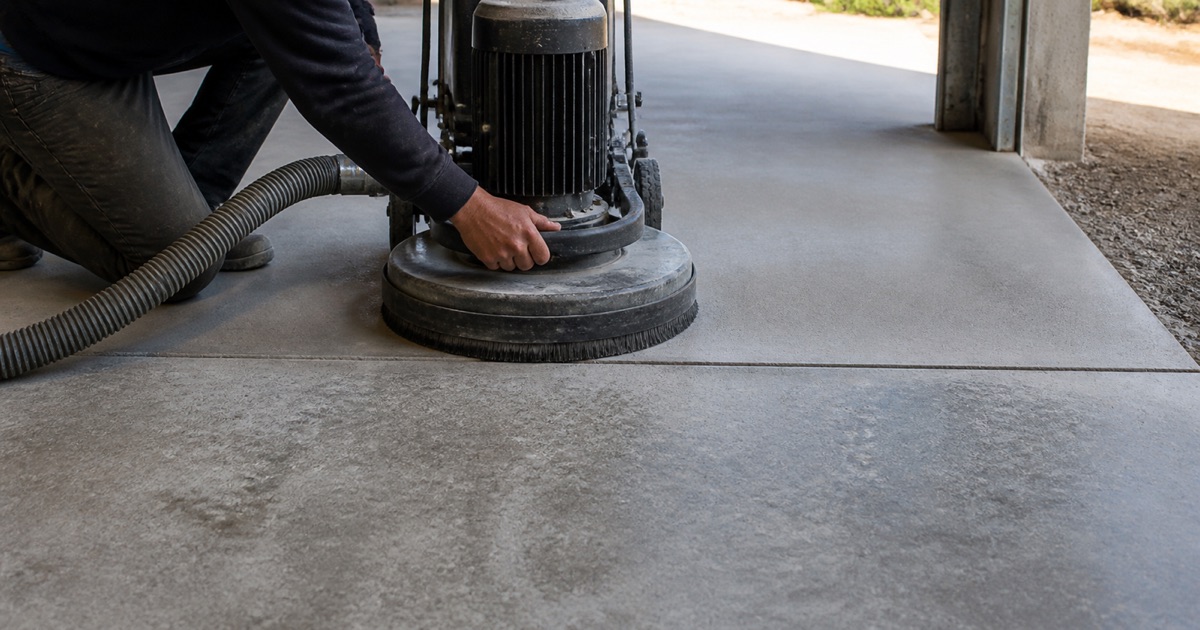
A planetary grinder with diamond segments is the default for residential slabs and most small commercial floors. It removes coatings, laitance and high spots, it flattens as it goes, and it produces a controllable profile because the operator can change segment and grit between passes. It is also the only one of the three that is practical to run inside an occupied building with dust extraction and containment.
Shot Blasting
A shot blaster throws steel media at the slab and recovers it, cutting a uniform profile fast across large open areas. It is the efficient choice on a big commercial floor because it prepares and vacuums in one pass, but it follows the slab’s existing contours rather than flattening them, and it struggles with edges, corners and soft or elastic coatings that deform under the shot instead of shattering.
Polycrystalline Diamond Tooling
PCD tooling is the specialist answer to a stubborn film. Where a thick elastomeric coating, mastic or an old kit gums up conventional diamonds, PCD segments shear it off the slab instead. It is aggressive and it leaves a scored surface that generally needs a follow-up grinding pass, so it is used as a removal step rather than as the finishing profile.
Segment Bond, Grit and Why One Sequence Does Not Fit Every Slab
The single most common mistake in this work is running the same tooling on every job. Diamond segments are consumables matched to the concrete, and the wrong choice either polishes the slab without cutting it or burns through segments at a rate that makes the job unprofitable and the profile inconsistent.
Hard Concrete Takes a Soft Bond
The rule reads backward until you understand what the bond is for. The metal matrix holding the diamonds has to wear away to expose fresh cutting edges. On hard concrete the slab does not abrade the bond fast enough, so a soft bond is used to let it erode and keep new diamonds working. On soft concrete the reverse applies and a hard bond keeps the segment from disappearing in an afternoon.
Stepping Through the Grits
We start coarse enough to remove what has to come off and step up in controlled increments, because a grit that jumps too far leaves scratches from the previous pass that no later step removes. How many steps a floor gets depends on the profile it is heading for. A floor being opened for a coating stops well short of the sequence a decorative polished finish would need.
Dust, Slurry and Keeping the Building Usable
Dry grinding with HEPA-rated extraction at the shroud is how we work indoors, and containment is planned before the machine comes off the trailer. Wet grinding produces slurry rather than airborne dust, sometimes the right answer outdoors, but it creates a disposal problem of its own. On a home we protect the door openings and the approach; in an occupied building we phase the area so the rest stays open.
Edges and corners are their own scope. A planetary machine cannot reach the perimeter, so edge grinders and hand tooling take the last few inches, slower per square foot than the open field. A quote that ignores it produces a floor with an untouched border where the coating lifts first.
Grinding as a Standalone Scope
Not every prep job ends with us coating the floor. We are regularly hired to grind and profile a slab for another trade, for a facility’s own installer, or ahead of a flooring product we do not install ourselves. In those cases we agree the target profile in writing beforehand, name the tooling and the grit sequence used, and leave the slab clean and vacuumed so the next crew is not inheriting an argument about whether the surface was ready.
- 20+ Years Experience
- Licensed & Insured
- Free Written Estimates