
Highland Epoxy Flooring installs flake epoxy floors throughout Highland, CA, and it is the system we have put down more often than any other in twenty-plus years of coating slabs here, serving surrounding cities including Redlands, Mentone, Loma Linda, Running Springs and San Bernardino. There is a reason for that. A flake floor is the only decorative system that is also the practical answer.
The chips are not paint and they are not sprinkles on top of a finished floor. They are broadcast into a wet base coat, buried by the layers that follow, and they end up carrying real thickness in the finished build. What you see is the pattern; what you get is a thicker, tougher, better-footed floor than the same money spent on a solid color.
Most of the demand here is the modal Highland garage: an attached two-car bay on a 1980s or 1990s tract slab, settled and cracked at its joints and usually carrying a coat of something from a previous owner. Flake is forgiving of everything that slab has been through, which is a large part of why it wins so consistently in this market.
What a Flake Floor Is Built From
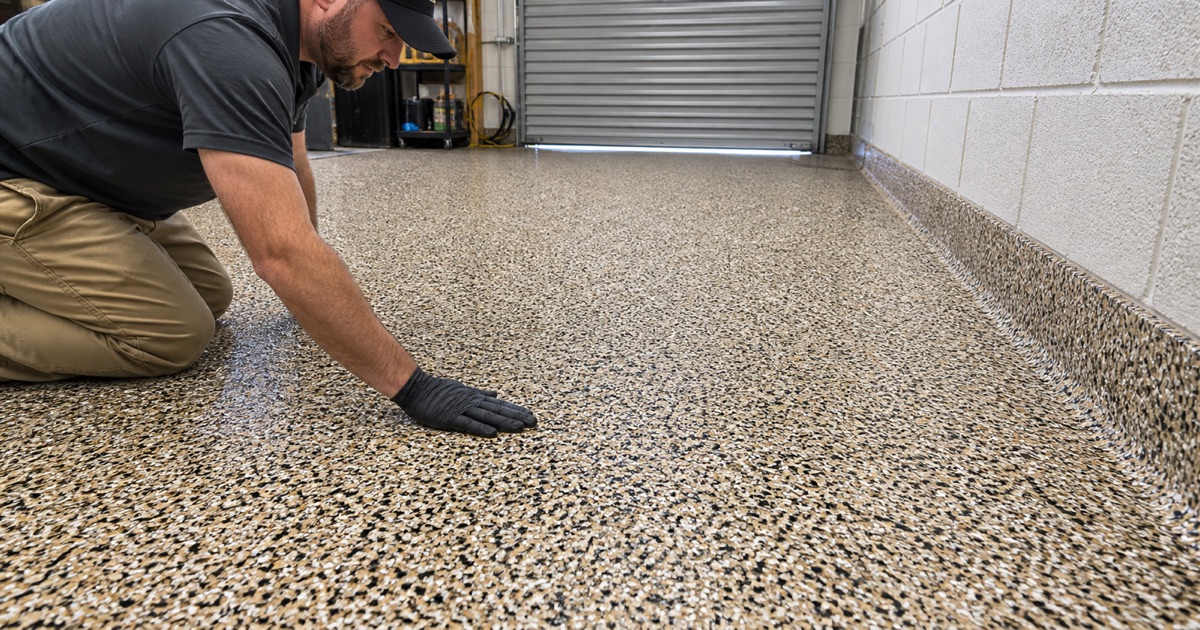
Three variables decide the finished result. All three should appear on a quote rather than being left to the crew’s discretion on the morning of the install.
The Chip Itself
The chips are colored vinyl, thin and rigid, manufactured to break light rather than to add color the way a pigment does. They come in named blends and can be mixed custom from individual colors, so a floor can be built around a base tone with one or two accents rather than picked off a card. Quartz aggregate is the alternative broadcast where slip resistance leads the specification instead of appearance.
Chip Size Changes the Whole Floor
Small chips read as texture and pattern from standing height, close to the look of a stone surface, and they are the easier choice in a smaller bay. Larger chips read as distinct pieces, give a bolder and more commercial appearance, and need more grout coat to fill between them. Neither is better; they are different floors, and the difference is far more visible at full size than on a sample.
Broadcast Rate, From a Scatter to Refusal
Broadcast rate is measured in pounds per square foot, and it runs from a light scatter that lets base color show through to a full broadcast thrown to refusal, where the surface will not accept another chip. A full broadcast hides the slab completely, adds the most thickness and costs the most in material and labor. Stating which one is being quoted is the difference between two bids that look comparable and are not.
The Step Nobody Sees on the Quote
What happens after the chips land is most of the labor in a flake floor. It is also where a cheap installation gets cheap.
Scraping and Vacuuming Back
A floor thrown to refusal has loose chips standing on edge across the whole surface once the base coat sets. Those get scraped down and vacuumed off, which is slow, unglamorous work and non-negotiable, because anything left standing telegraphs through the topcoat as a rough point. Skipping it produces the sandpaper floor people complain about.
The Grout Coat That Fills Between the Chips
A clear grout coat is then flooded on to fill the valleys between chips and bring the surface toward level. How far that filling is taken sets the final texture: more grout gives a smoother, easier-to-clean floor, less gives more grip. That is a deliberate decision about the room, and a garage where wet cars come in off a sloping driveway is a different answer from a finished gym.
The Topcoat and the Floor You Actually Live With
The topcoat carries the gloss, the abrasion resistance and the chemical resistance, and on a floor exposed to sun it needs to be aliphatic so it does not amber. It is also the layer that gets renewed years later without disturbing the flake underneath, which means a flake floor can be refreshed rather than replaced.
Choosing a Blend for a Highland Garage
Roughly 8,100 owner-occupied detached houses sit in this city and about three quarters of the housing is single-family detached, so the blend conversation happens in a garage far more often than anywhere else.
Reading a Blend at Full Size
A sample card and a whole two-car bay are not the same object. We would rather bring a large sample board into the bay itself and look at it under the light the room actually has, with the door open and then closed, than settle a color at a desk. Blends with high internal contrast in particular gain a lot of visual energy at scale.
Color That Suits What a Garage Does
A garage floor collects tire marks, dust off a driveway and the occasional drip, and a mid-tone blend with visible variation hides all of that far better than a very dark or very pale one. Dark floors show dust and light floors show everything else. That is a practical argument rather than a taste one, and it is worth hearing before falling for a blend that will need mopping twice a week.
Matching a Second Bay or a Later Addition
Because the appearance comes from a blend rather than from a pour, a flake floor is reproducible in a way a poured decorative floor is not. A detached shop coated two years after the attached garage can be given the same blend at the same broadcast rate and read as one continuous project, which is exactly the phasing a lot of households here end up wanting.
- 20+ Years Experience
- Licensed & Insured
- Free Written Estimates