
Highland Epoxy Flooring handles pool deck resurfacing and deck coating in Highland, CA and the surrounding cities including Redlands, Mentone, Loma Linda, Running Springs and San Bernardino. A pool deck is the one slab on a residential property where three requirements pull against each other at once, and the job is mostly about refusing to sacrifice any of them to make a product choice easier.
Those three are grip, temperature and chemistry. The surface has to hold a wet bare foot, it has to stay tolerable to stand on in full sun, and it has to shrug off chlorinated splash-out, salt from a chlorine generator and constant ultraviolet exposure. A system that wins on one of those and loses on another is a deck the family stops using.
We quote a pool deck against all three explicitly, along with the drainage the deck already has, because a coating changes surface elevation slightly and anything that ponds around a pool is both a slip problem and a maintenance one.
Barefoot Traffic Sets the Slip Number
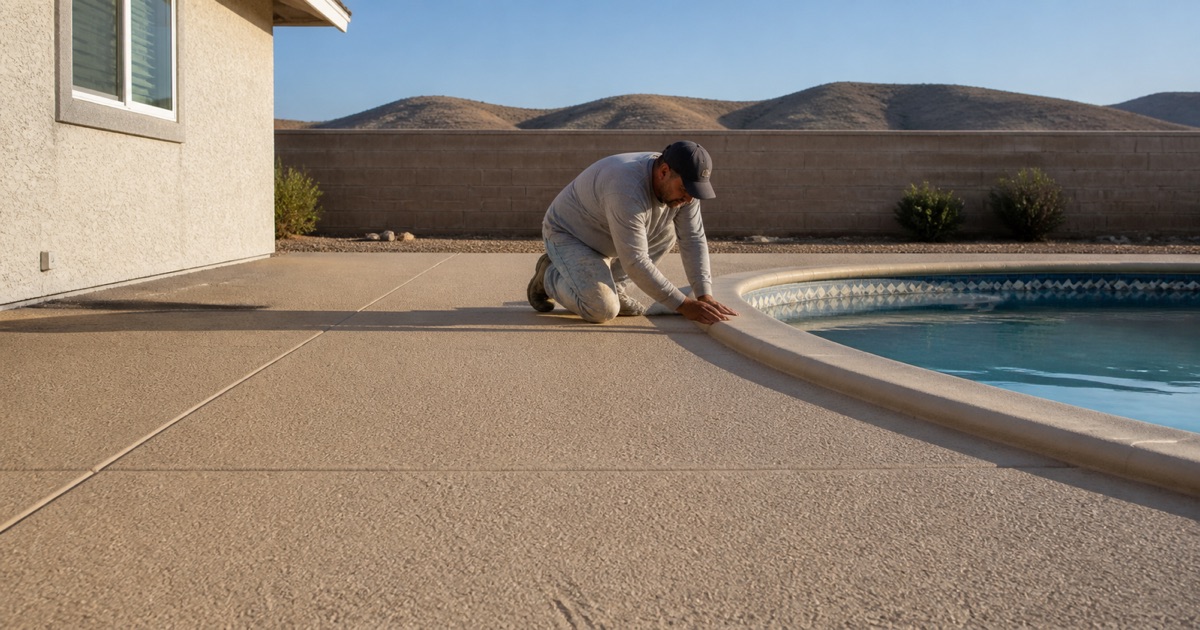
Slip resistance around a pool is not a feature to be described, it is a number to be specified. What is worth asking any contractor for is a wet dynamic coefficient of friction figure, since a dry deck was never the hazard, together with the aggregate and broadcast rate that produce it.
Texture Aggressive Enough to Grip, Gentle Enough to Kneel On
That number is delivered by texture, and texture has a comfort ceiling on a surface people sit and kneel on with bare skin. A broadcast that would be right on a commercial ramp is punishing around a pool. We aim for the finest texture that still holds a wet foot, usually a fine aggregate or a knockdown profile rather than a coarse quartz broadcast, and we will put a sample down so it can be walked on before the whole deck commits to it.
Where the Texture Has to Change
A deck is rarely one condition. Steps, the coping edge and any slope toward a drain carry more risk than the flat lounging area, and they can be finished with a slightly more aggressive texture while the open deck stays comfortable. Treating the whole surface as one specification is how a deck ends up either too rough everywhere or too slick at the one spot where it mattered.
Color Is a Temperature Decision Outdoors
Surface temperature is a real constraint on an inland deck, not a comfort footnote. A dark slab in full afternoon sun can climb toward the 160 degrees F ceiling that resin manufacturers name as a maximum surface temperature, and long before that it is too hot to stand on. That makes color part of the specification rather than the last decision on the list.
Lighter colors and infrared-reflective pigments both lower the surface temperature meaningfully, which is why the palette on a pool deck is narrower than the one on a garage floor. We would rather talk a homeowner out of a dark charcoal deck in advance than hand over a surface the family avoids from noon to five.
Systems That Survive UV, Chlorine and a Salt Cell
Product selection outdoors is governed by ultraviolet exposure first. Epoxy is an excellent bonding and body material and a poor exposed surface in direct sun, because it ambers and chalks. That is not a defect to work around, it is a reason to put something else on top of it.
Aliphatic Topcoats Over the Body Coat
Polyaspartic and polyurea topcoats are UV stable, cure fast and hold color, so an outdoor system is usually built as a primer and body coat carrying the texture with an aliphatic topcoat over it. That layered approach is what keeps a deck the color it was on day one after several summers of direct sun.
Chlorine, Salt and Splash-Out
Chlorinated water and the salt from a chlorine generator are both mild chemical exposures individually and relentless in combination, concentrated in a band around the waterline where splash-out lands and evaporates. We extend the specified system to the coping edge rather than stopping it short, and we look for existing efflorescence and salt staining during the walk-through, because both are signs of water moving through the deck slab.
Cementitious Texture Coats
Where the deck is sound but tired, a thin polymer-modified cementitious texture coat troweled or knocked down over a mechanically opened slab gives grip and a fresh appearance at lower cost than a full resin build. It takes integral color and a clear sealer, and it is the sensible answer on a deck whose problems are cosmetic rather than structural.
The Details Around the Water
The perimeter is where deck coatings fail, and it is where a fast quote skips. The joint between the deck and the coping is a movement joint and has to stay one, so the coating is terminated cleanly at it and the joint is filled with a flexible sealant rather than bridged with hard material that will crack in a season.
Expansion joints across the deck get the same treatment, and deck drains and the fall toward them get checked before anything goes down. A coating adds thickness, and on a deck already draining marginally that is enough to create a puddle that was not there before. Where the fall is genuinely wrong we say so, because no coating fixes a slope problem.
Working Around the Weather Window
Cure conditions govern the schedule more than the calendar does. Pot life is a curve against temperature, not a fixed figure: a published system that gives roughly an hour of working time on a 55 degrees F slab leaves about a third of that once the deck reaches 95, and the shortest wait it permits before the next coat drops from a full day to six hours over the same span. The surface also has to sit a clear 5 degrees F above the dew point before a film goes on, or it blushes.
In practice that means early starts, small batches and a real conversation about which days the pool is out of use. It also means the residential product line, because a home pool deck falls under the 50 g/L VOC floor coating limit in SCAQMD Rule 1113, and the higher-limit industrial maintenance category is not legal to apply at a residence.
- 20+ Years Experience
- Licensed & Insured
- Free Written Estimates